
Stop 2 The Sanctuary
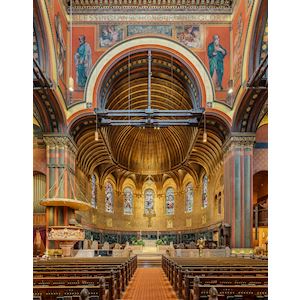
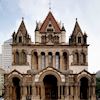
Take a few moments to look around the room from this vantage point. Is this what you thought the church was going to look like? Compare what you’re seeing with what you might have expected from looking at the exterior of the church. Now think about other churches you’ve seen, and consider what’s different about the interior you’re standing in today. What surprises you? What details do you notice? How does the church make you feel? As you think about these questions, we’ll cover a little bit of the history of the church and how this building came to be here in Copley Square. When Trinity was founded in 1733 it was a parish in the Church of England. After the American Revolution, the Anglican churches in the United States formed what is now the Episcopal Church. Trinity’s original site was in an older part of the city, where it prospered for many years. But by the middle of the nineteenth century the parish had a dwindling membership, because it was isolated in what had become a largely commercial part of Boston. A new life for Trinity began with the arrival of a young, charismatic rector, Phillips Brooks. His arrival in 1869 reinvigorated the parish, which grew quickly. The congregation needed a more suitable location, and, in 1872, they purchased the prominent plot of land here in Copley Square where you find Trinity today. The congregation’s timing was excellent because the old church was destroyed in the Great Boston Fire that same year! A competition was held to select the architect to design the new church. H. H. Richardson and his bold new design won the day. Educated at Harvard, Richardson studied architecture in Paris at the École des Beaux Arts, the academy of fine art, and was among the very first Americans to be trained there. Here at Trinity, Richardson developed his signature style. It’s a re-expression of an early medieval European form, called the Romanesque. Characterized by round arches, the Romanesque style was freely adapted by Richardson to improve its visual appeal with the clear and rational use of brownstone trim and decorative motifs. The building is organized around the massive central tower and creates an overall effect of monumentality and permanence but also a clear sense of newness and originality . . . a truly American style. Richardsonian Romanesque quickly became very popular for civic and commercial buildings such as libraries, town halls, courthouses, and train stations. If you’d like to hear more about the construction of the church, press the A button on your player, now. Page Break First called Arts Square, and the original home of the Museum of Fine Arts, Copley Square was the heart of Boston’s most fashionable new residential area, the Back Bay. Trinity was one of many churches that moved to this new part of Boston. The actual construction of the church took about three and a half years, at a final cost of about $750,000. The land here was created between 1850 and 1890 by filling in close to 500 acres of tidal marshes. It was one of a number of land-making projects in Boston designed to provide housing for the growing population Before construction of the church began, there was a period of careful engineering study and refinement of the original design. As with most other buildings of the time in the marshy Back Bay, Trinity’s foundation was, and still is, supported by wooden pilings. The pilings are 35- to 40-foot timbers, which resemble telephone poles. 4,500 of these were driven down through the gravel fill with steam pile drivers. They are still there supporting the walls of the church more than 140 years later. Provided that the wooden piles are not exposed to oxygen and remain saturated with water, they’ll remain solid indefinitely.
Trinity Church in the City of Boston
Hello and welcome to Trinity Church in the City of Boston. Trinity is a National Historic Landmark, a designation by the United States Park Services that marks it's significance not only to Boston, but also to the entire nation and one of the true gems of nineteenth-century American architecture. Here you will see why The American Institute Of Architects has ranked Trinity Church among the top ten buildings in the country.
- 206 Clarendon St.
- Boston United States
- 617-536-0944
- www.trinitychurchboston.org
