
Stop 5 The Chancel
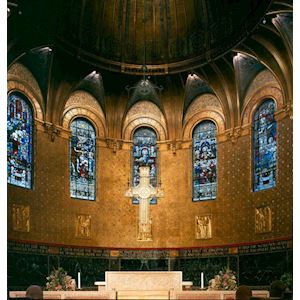
We’re now facing the part of the church called the chancel, which is where we find the altar. The chancel at Trinity has undergone a number of changes over the years. What you’re seeing today is the result of a major redecoration completed in 1938. Look at some of the key elements of the decoration. These include: The upper part of the curved wall, which is decorated with blue and red stenciling over gold leaf; The lower part of the curved wall, where you can see the carefully matched panels of green marble sheathing; The altar, with its raised, intricately carved white and gold marble and mosaics; The altar rail, decorated with pink marble; and the dramatic central feature: the carved, gilt wooden cross suspended from the ceiling. If you look at each end of the cross you’ll see the symbols of the Gospel writers: Mark (the lion), Luke (the ox), Matthew (the angel) and John (the eagle). Under the stained-glass windows in the chancel are seven plaques made of gilded-marble. These were carved by Boston sculptor Ernest Pellegrini. They depict important figures in the history of Christianity, from Saint Paul on the far right to Phillips Brooks all the way over on the left. To your left is the large, raised circular pulpit, made of intricately carved oak, which was installed in 1916. Above the pulpit is a canopy, which is actually a sounding board designed to help project a speaker’s voice out into the room. Remember, there were no microphones then. On the right side of the chancel is the brass eagle lectern from which scripture is read during services. Here, the eagle is not a national symbol, but rather represents the Word of God flying outward to the people. You might have noticed Trinity’s organs. To find out about these impressive instruments, press the A button on your player. To find out about the stained glass windows at Trinity, press the B button on your player, now. Organs Music is an integral part of the worship experience at Trinity. And we have two magnificent organs to support the music program. Both instruments are from the famous Boston maker, Aeolian-Skinner. One is located above the chancel to your left and the other is behind you in the far gallery. With a total of more than 7,000 pipes, they’re both played from the console that you can see on the right-hand side of the chancel, about halfway back. To find out about the stained glass windows at Trinity, press the B button on your player, now. Stained Glass Windows There are seven stained-glass windows directly in front of you, on the curved wall of the chancel. These windows were the first to be acquired by the church in 1877–78. Designed and fabricated by the London firm of Clayton and Bell, these Gothic Revival windows illustrate seven scenes from the life of Christ. On the left, you can see the nativity scene, and on the far right is Jesus’s commission to the Apostles. These finely crafted windows use jewel-tone colors, verticality, and lack of dimension to re-create the feel of medieval stained glass. Renowned for their variety, quality, and innovation, the windows form an important part of the decorative program of the Church. They were acquired over a period of fifty years, beginning in 1877, and come from the leading stained-glass studios of the time. They replaced temporary leaded glass windows similar to what you see in the entrance doors. Most windows were memorial gifts to the church, and in addition to texts from scripture, you’ll often see the name of the person to whom the window was dedicated. The donors had some say in both the design and the subjects depicted in the windows –– this is one reason the stained glass at Trinity Church is so diverse, and not rigidly uniform, as is often seen in other churches of the time.
Trinity Church in the City of Boston
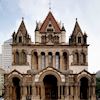
Hello and welcome to Trinity Church in the City of Boston. Trinity is a National Historic Landmark, a designation by the United States Park Services that marks it's significance not only to Boston, but also to the entire nation and one of the true gems of nineteenth-century American architecture. Here you will see why The American Institute Of Architects has ranked Trinity Church among the top ten buildings in the country.
- 206 Clarendon St.
- Boston United States
- 617-536-0944
- www.trinitychurchboston.org
