
Stop 7 The Baptistery
Look into the room we call the baptistery, because of the large alabaster and marble baptismal font in front of you. Now, look up at the elegant stained-glass window, which depicts David’s Charge to Solomon. Like Trinity’s Christmas windows, this stained-glass masterpiece was also created by the team of Edward Burne-Jones and William Morris and was installed in 1882. We see old King David instructing his son Solomon on the temple that Solomon must build. Notice the solemn, stylized faces of the figures in this window. To discover which face doesn’t belong in this stained-glass design, Press the A button. Or to learn more about Trinity’ charismatic rector in the nineteenth century, Phillips Brooks, press the B button on your player, now. King David is the same David who, as a youth, slayed the giant Philistine Goliath with his slingshot. Look at the upper right corner of the window and notice the flag held by a soldier. It shows the scene of young David holding the death-grey disembodied head of Goliath with a fatal wound on his forehead. This is actually a likeness of William Morris, the owner of the studio that made the window! The artist Edward Burne-Jones was having a bit of fun at the expense of Morris! On the right-hand wall, opposite the stained glass, is a bust of the rector Phillips Brooks. It was commissioned after his death in 1892. It’s The sculptor was Daniel Chester French, who’s most famous for his statue of Abraham Lincoln at the Lincoln Memorial in Washington, D.C. To learn more about Phillips Brooks, press the B button on your player, now. Here you see a bust of Phillips Brooks by Daniel Chester French. Brooks served Trinity for twenty-two years. He was a native Bostonian and had descended from a long line of New England clergy. He was educated at Boston Latin School, Harvard College, and Virginia Theological Seminary. Brooks was only in his mid-thirties when he was called to Trinity. At that early stage in his career, he had already become a nationally recognized preacher. Brooks had a magnetic personality and preached a fresh and optimistic message that spoke directly to his enthusiastic followers. During his time at Trinity, Brooks’ fame spread –– he was the first American to preach at Westminster Abbey, received honorary doctorates from Harvard and Oxford Universities, and had numerous church and academic opportunities elsewhere - all of which he turned down. He felt that his true calling was to be a parish priest. Eventually, he become became bishop of Massachusetts in 1891. He died after only 18 months in that position, at the age of 57. Brooks was also a poet, and after a trip to the Holy Land immediately after the end of the Civil War, he wrote the words to the Christmas carol O Little Town of Bethlehem.

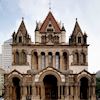
Trinity Church in the City of Boston
Hello and welcome to Trinity Church in the City of Boston. Trinity is a National Historic Landmark, a designation by the United States Park Services that marks it's significance not only to Boston, but also to the entire nation and one of the true gems of nineteenth-century American architecture. Here you will see why The American Institute Of Architects has ranked Trinity Church among the top ten buildings in the country.
- 206 Clarendon St.
- Boston United States
- 617-536-0944
- www.trinitychurchboston.org
