
Stop 8 LaFarge Stained Glass
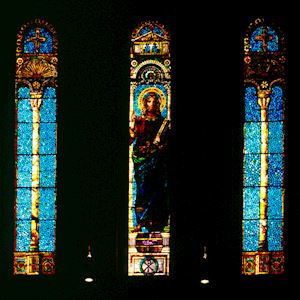
Look straight ahead, on the far wall, to see Trinity’s most important stained-glass window. Consisting of three lancets, it’s called Christ Preaching and was the work of our decorator, John LaFarge! The window was installed in 1883 and is considered by many to be one of the finest examples of nineteenth-century American stained glass. It’s a tour de force of LaFarge’s innovative techniques. The turquoise grounds of the outer lancets of Christ Preaching are a mosaic of white, blue, and green nuggets of glass. There are 2,700 glass pieces, and each one is faceted and about the shape and size of a golf ball. The effect is dazzling. The donors of this window remain anonymous, but Phillips Brooks reportedly asked LaFarge to “give me something to inspire me when I preach.” This was the artist’s superb response. To find out what makes LaFarge’s windows unique, press the A button now. Prior to LaFarge, stained-glass windows were made using the same techniques that had been used for centuries, going back to Medieval times. The images were created with a special paint containing glass particles applied to pieces of transparent, colored glass. The glass was fired in a kiln to fix the images, and the pieces of glass were then set together in a lead framework. LaFarge loved stained glass, but he felt the medieval techniques limited the artist’s ability to create images with color and light. Quite by accident, one day he came upon the idea of using a new material when he noticed his toothpaste jar against the light of an open window. The jar was made of opalescent glass –– meaning glass in which light-reflecting particles are suspended, creating a milky iridescent effect. At that time, white opalescent glass was used as an inexpensive substitute for porcelain and for medicine containers. LaFarge saw its potential and introduced it into the design of his stained-glass windows. Eventually, opalescent glass became available in an almost infinite variety of colors, blends of colors, and textures. LaFarge also plated the glass in multiple layers, to further expand the color palette and disguise the lead lines. Another innovation was the inclusion of smaller, three dimensional pieces of glass and non-glass material into the design. The use of painting is limited to the face and hands, and the bulk of the image is created with the glass itself. In essence, LaFarge moved from the traditional painting on the glass to painting with the glass.
Trinity Church in the City of Boston
Hello and welcome to Trinity Church in the City of Boston. Trinity is a National Historic Landmark, a designation by the United States Park Services that marks it's significance not only to Boston, but also to the entire nation and one of the true gems of nineteenth-century American architecture. Here you will see why The American Institute Of Architects has ranked Trinity Church among the top ten buildings in the country.
- 206 Clarendon St.
- Boston United States
- 617-536-0944
- www.trinitychurchboston.org
